Monday, December 8, 2025
Final Presentation: Evolution of American Freedom
Saturday, December 6, 2025
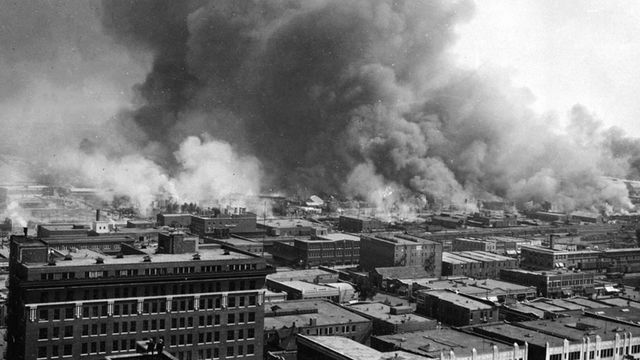
Remembering the Tulsa Race Massacre of 1921
The Tulsa Race Massacre of 1921 remains one of the darkest and most devastating episodes in American history. At the time, Tulsa, Oklahoma, was home to Greenwood, a thriving African American community often referred to as “Black Wall Street.” Greenwood was a symbol of Black prosperity, with flourishing businesses, schools, churches, and cultural life. Yet, its success became a target for racial hostility in a segregated society.
On May 30, 1921, an encounter between Dick Rowland, a young Black man, and Sarah Page, a white woman, sparked rumors that quickly spread through Tulsa. Though the details were unclear, the incident inflamed racial tensions. By May 31, a white mob had gathered outside the courthouse where Rowland was being held. What began as a confrontation escalated into one of the worst acts of racial violence in U.S. history.

Over the next eighteen hours, Greenwood was systematically destroyed. White mobs looted homes and businesses, set fires, and even used airplanes to drop incendiary devices on the neighborhood. By the time the violence ended, as many as 300 Black residents had been killed, more than 1,000 homes and businesses were reduced to ashes, and thousands of survivors were left homeless. Many were detained in internment camps, stripped of their freedom and dignity.
The massacre was not only a physical destruction but also an erasure. Newspapers and officials largely suppressed the story, and for decades it was omitted from history books. Survivors rarely spoke of it, fearing retaliation and further trauma. Greenwood’s legacy was buried, and the tragedy remained hidden from national memory.
In recent years, however, the Tulsa Race Massacre has finally received the recognition it deserves. Survivors like Viola Fletcher, who lived to be 111, spent their lives advocating for acknowledgment and reparations. Their voices, along with renewed scholarship and activism, have brought Greenwood’s story back into public consciousness. Efforts to preserve the neighborhood’s legacy and honor its victims continue, ensuring that the truth is not forgotten.

Today, the massacre is recognized as one of the worst incidents of racial violence in U.S. history. It serves as a powerful reminder of the destructive force of racism and the resilience of those who endured unimaginable loss. Remembering Greenwood is not only about honoring the victims but also about confronting the past to build a more just future.
AI Disclosure: This post was drafted with the assistance of Microsoft Copilot, an AI companion designed to help synthesize information and create clear, structured writing.
The Rise and Decline of the KKK in the 1960s
The 1960s were a defining era in American history, shaped by the Civil Rights Movement and the violent backlash it provoked. Among the most notorious forces of resistance was the Ku Klux Klan. The Klan’s resurgence during this decade was fueled by the push for desegregation after Brown v. Board of Education and the growing visibility of civil rights activism. Although fragmented and not always unified, the Klan gained support from certain politicians, police officers, and public officials, using propaganda, rallies, and violent intimidation to spread fear.
Freedom Summer in 1964 highlighted the Klan’s brutality. Civil rights workers James Chaney, Andrew Goodman, and Michael Schwerner were murdered while investigating the burning of a Black church in Mississippi. This tragedy underscored the risks activists faced while registering Black voters. Similarly, the bombing of Birmingham’s 16th Street Baptist Church in 1963 killed four young girls and injured dozens more, shocking the nation and strengthening support for civil rights legislation.

Despite “massive resistance” to school desegregation and symbolic acts like Governor George Wallace’s “stand in the schoolhouse door” at the University of Alabama, progress could not be stopped. Landmark legislation followed: the Civil Rights Act of 1964 outlawed segregation and employment discrimination, while the Voting Rights Act of 1965 banned literacy tests and poll taxes, dramatically increasing Black voter registration.
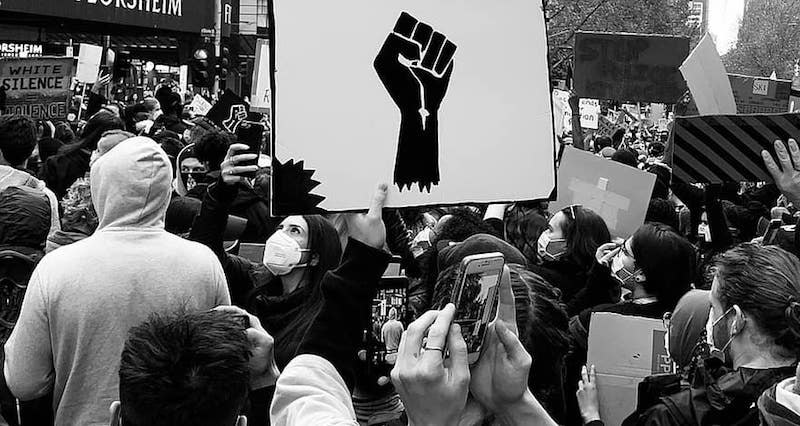
Grassroots activism also played a crucial role. The Greensboro sit-ins of 1960 inspired hundreds of similar protests, while the March on Washington in 1963 brought over 200,000 people together to hear Martin Luther King Jr.’s iconic “I Have a Dream” speech.
By the late 1960s, the Klan’s influence declined as federal enforcement, public outrage, and civil rights victories reshaped the nation. The decade proved that while hate groups could terrorize, they could not stop the march toward justice.
AI Disclosure: This blog post was drafted with the assistance of Microsoft Copilot, an AI companion designed to help synthesize information and create clear, structured writing.
Thursday, October 30, 2025
Reconstruction and Beyond: Building the Foundations of Black Empowerment
To support newly freed African Americans, Congress created the Freedmen’s Bureau in 1865—the first federal welfare agency. It helped over 4 million people, establishing more than 4,000 schools and laying the foundation for Historically Black Colleges and Universities (HBCUs), which educated 250,000 students by 1870. The Bureau also provided legal protection through 800,000 court cases and helped reunite families and validate marriages.
Reconstruction and Beyond: Building the Foundations of Black Empowerment
The end of the Civil War marked a turning point in American history, but freedom for formerly enslaved people came with deep challenges. The 13th Amendment abolished slavery, declaring that neither slavery nor involuntary servitude shall exist in the United States. Yet, while it ended slavery legally, it did not guarantee equality. The 14th Amendment followed, granting citizenship to all born in the U.S. and promising equal protection under the law. Despite its intent to protect the rights of former slaves, many states ignored its provisions. The 15th Amendment took another bold step, prohibiting the denial of voting rights based on race, color, or previous servitude—giving Black men the right to vote. However, discriminatory practices like poll taxes and literacy tests undermined its impact.
One of the most symbolic promises of Reconstruction was “40 acres and a mule,” intended to provide land to freed families. Tragically, President Andrew Johnson reversed this order, returning land to former enslavers and forcing Black families into exploitative sharecropping. This broken promise left a lasting legacy and remains a powerful symbol in reparations discussions.
Institutions like the Tuskegee Institute, founded in 1881 by Booker T. Washington, embodied the spirit of Black empowerment. Starting with one teacher and 30 students, Tuskegee emphasized vocational and academic education. Students built their own classrooms, and under leaders like George Washington Carver and architect Robert R. Taylor, the school became a beacon of innovation. Tuskegee Airmen trained there, becoming WWII heroes.
Trailblazers like Hiram Rhodes Revels, the first African American senator, and Joseph Hayne Rainey, the first Black U.S. representative, broke political barriers in 1870. Revels, born free in North Carolina, was a minister and educator who advocated for racial reconciliation. Rainey, born enslaved, fought for civil rights and protection from violence. Their legacies underscore the enduring struggle for equality and representation in America.

This information came from my notes and was put together by Copilot AI
Defending the Separate Car Act in Politics
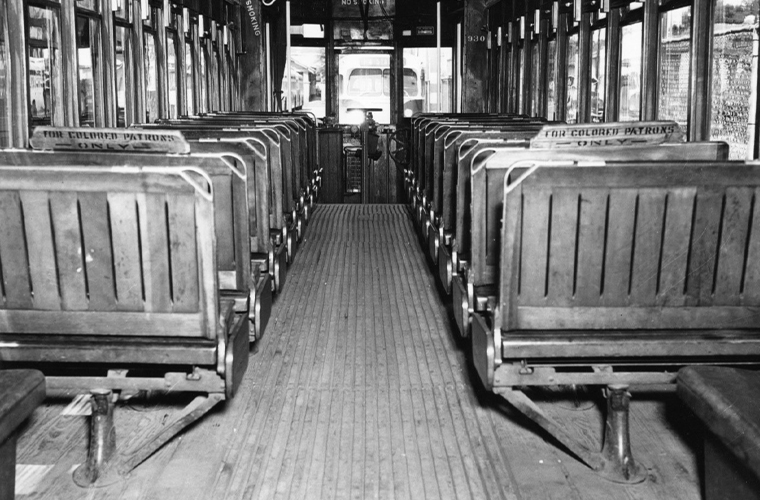
Segregation, as practiced in Louisiana and throughout the South, is not a product of racial animus. It is a reflection of longstanding customs and a practical measure to maintain public peace. The races have historically lived separately—by choice and by tradition. To compel their close association in confined spaces such as railway cars would not foster unity, but rather provoke tension and discord.
In Defense of the Separate Car Act: A Case for State Sovereignty and Social Prudence
In the ongoing discourse surrounding the Separate Car Act, it is imperative to look beyond the surface of statutory language and examine the deeper principles of governance, constitutional interpretation, and societal harmony. The State of Louisiana, in enacting this law, has exercised its sovereign right to legislate for the welfare of its people—a right enshrined in the very fabric of our federal system.
The Separate Car Act mandates that railway companies provide distinct accommodations for white and colored citizens. Critics argue that this constitutes a violation of the Fourteenth Amendment. However, such a reading stretches the intent of that amendment beyond its original scope. The Fourteenth Amendment guarantees equality before the law, not the forced mingling of races in social or public settings. The framers did not seek to erase all distinctions based on race, nor did they envision a society where every social interaction must be integrated.
The State’s police powers grant it the authority to regulate conduct in the interest of public safety, health, and morality. The Separate Car Act is not an instrument of oppression; it is a framework for organization. It ensures that all citizens receive equal accommodations, albeit administered separately. This approach respects both constitutional mandates and the cultural norms of our communities.
Moreover, the law enjoys broad support among the populace. The white citizens, who bear the primary responsibility of governance, have deemed it necessary. The colored citizens, though recently enfranchised, are not denied access to transportation—they are simply directed to separate facilities. This is not a question of superiority or inferiority; it is a matter of practicality. Just as society provides separate restrooms for men and women, it may reasonably provide separate accommodations for different races without violating principles of justice.
To strike down this statute would be to invite social upheaval. It would disrupt the delicate balance that has allowed communities to coexist peacefully. The Constitution does not demand such radical change. It permits states to act wisely and in accordance with their unique circumstances. Louisiana has done so, and its judgment should be respected.
In defending the Separate Car Act, we defend not only a law but the principle of state sovereignty, the preservation of public order, and the right of communities to govern themselves in a manner consistent with their values and experiences. Let us not confuse equality with uniformity, nor justice with forced integration. The law recognizes difference—not inequality—and in doing so, it upholds both the Constitution and the peace of our society.
This was a presentation turned into a post by Copilot AI
From Emancipation to Migration: The Long Road to Freedom
The story of African Americans in the United States is one of resilience, determination, and transformation. Between 1916 and 1970, the Great Migration marked a seismic shift in American society. Millions of Black Americans left the oppressive South—where Jim Crow laws enforced racial segregation—and headed north in search of opportunity. Black newspapers spread the word, and families boarded trains toward cities like Chicago, Detroit, and New York. They found work in factories and earned paychecks, but the North was no promised land. Despite facing discrimination, most never returned to the South, choosing instead to build new lives.
This journey toward freedom began long before the migration. After the Civil War, the 13th Amendment abolished slavery, but true equality remained elusive. The 14th and 15th Amendments granted citizenship and voting rights to Black men, and by 1868, voter registration among African Americans in the South soared. Sixteen Black Americans served in Congress during Reconstruction, proving that multiracial democracy was possible. Yet, this progress was short-lived. The end of Reconstruction in 1877 ushered in a new era of disenfranchisement and racial violence.
One beacon of hope was Booker T. Washington, born into slavery in 1856. He taught himself to read, walked 200 miles to attend school, and later founded Tuskegee Institute—a place where African Americans could gain practical skills. Though his philosophy faced criticism, Washington’s legacy endures.
The assassination of Abraham Lincoln in 1865 was a turning point. His moderate approach to Reconstruction was replaced by Andrew Johnson’s leniency toward the South, allowing Black Codes to flourish. Congress responded with Reconstruction Acts and constitutional amendments, but the damage was done.
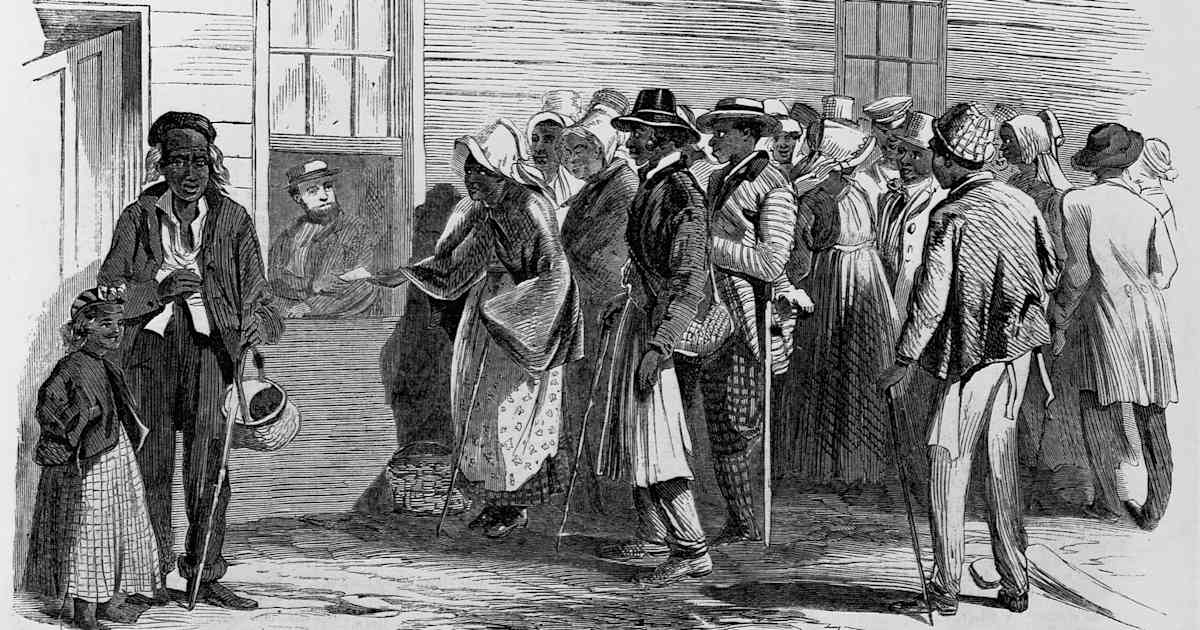
Even after emancipation, sharecropping trapped Black families in cycles of debt and poverty. The Freedmen’s Bureau, America’s first federal welfare agency, helped over four million people, but systemic barriers remained.
This history reminds us: freedom is not just a legal status—it’s a lived reality that must be fought for, generation after generation.
This was taken from notes I put together and turned into a post by Copilot AI
Tuesday, October 28, 2025
Reconstruction, Resistance, and the Struggle for Racial Justice (1865–1930s)
In the aftermath of the Civil War, Southern states passed the Black Codes (1865–1866) to control newly freed African Americans and maintain white supremacy. These laws imposed harsh legal restrictions, effectively recreating slavery through forced labor, vagrancy laws, and limited civil rights. Though slavery had ended, true freedom was still denied. Northern outrage over these codes helped push Congress to act, leading to the creation of the Freedmen’s Bureau (1865), the Civil Rights Act of 1866, and eventually the 14th Amendment, which granted citizenship and equal protection under the law. The Black Codes also laid the groundwork for Jim Crow laws, which enforced racial segregation for decades.
During Reconstruction, “carpetbaggers”—Northern opportunists—moved south, often with good intentions. They helped establish public schools, promoted infrastructure like railroads, and worked with freedmen and Southern Republicans to pass civil rights legislation. However, many white Southerners viewed them as corrupt intruders, symbols of Northern domination. This resentment fueled violent resistance, most notably from the Ku Klux Klan (KKK).
Founded in 1865 in Tennessee by former Confederate soldiers, the KKK began as a secret social club but quickly evolved into a violent organization. Its early goals were to resist Reconstruction and restore white supremacy. The Klan used fear, threats, and brutal violence—especially targeting African Americans and their allies—to undermine progress and intimidate voters.
One of the Klan’s most horrific tools was lynching. Used to terrorize Black communities, lynching peaked in the 1880s and 1930s, with over 4,000 documented Black victims. These acts were often public spectacles with community participation, reinforcing racial hierarchy and white dominance. Offenders were rarely prosecuted, and federal anti-lynching legislation wasn’t passed until 2022. The trauma of lynching left a lasting scar on American history and contributed to forced migration of Black families seeking safety.
The assassination of President Abraham Lincoln on April 14, 1865, at Ford’s Theatre by actor John Wilkes Booth—a Confederate sympathizer—shocked the nation. Lincoln died the next morning, and Booth was killed after a 12-day manhunt. Eight people were tried for conspiracy; four were hanged. Lincoln’s death marked a turning point, leaving Reconstruction in the hands of less sympathetic leaders and deepening national divisions.
Another form of institutional racism was anti-miscegenation laws, which banned interracial marriage in 30 states. These laws aimed to preserve white racial purity and were enforced with harsh punishments. They remained in place for decades until the landmark Supreme Court case Loving v. Virginia (1967) declared them unconstitutional. Yet, their legacy lingered, reflecting the deep entrenchment of racial prejudice in American law and society.
Together, these events and policies illustrate the fierce resistance to racial equality during Reconstruction and beyond. Despite constitutional amendments and federal efforts, white supremacy persisted through legal, social, and violent means—shaping the racial landscape of the United States for generations.
This information came from my notes I took and was put together by Copilot AI
Thursday, October 23, 2025
Why Louisiana’s Separate Car Act Upholds Constitutional Order
In the case of Plessy v. Ferguson, the State of Louisiana stands firm in its defense of the Separate Car Act—a law requiring separate railway accommodations for white and colored citizens. Critics claim this statute violates the Fourteenth Amendment. I respectfully disagree. This law is not only constitutional—it is essential to preserving public order and respecting the customs of our society.
The Fourteenth Amendment guarantees equal protection under the law. It does not, however, mandate social integration. The framers of that amendment did not intend to erase all distinctions between the races. They sought to ensure legal equality, not to force unnatural social mingling. The Separate Car Act provides equal accommodations for both races. It does not deny access—it simply organizes it.
Segregation, as practiced in Louisiana and throughout the South, is not born of hatred or hostility. It is a reflection of long-standing social customs and practical realities. The races have historically lived separately, attended separate schools, and worshipped in separate churches. To compel their forced association in confined public spaces—such as railway cars—would invite tension, not harmony.![]()
The State of Louisiana has the sovereign right to legislate for the welfare of its people. Under the Constitution, states possess police powers to regulate public safety, health, and morality. The Separate Car Act is a legitimate exercise of that power. It does not degrade—it distinguishes. It does not oppress—it protects. Just as men and women are provided separate facilities, so too may the races be separated without offense to justice.
Moreover, the law reflects the will of the people. The white population, which bears the burden of governance, has deemed it necessary. The colored population has not been excluded—only directed to separate accommodations. This is not a question of inferiority. It is a question of practicality and public peace.
To strike down this law would be to invite social upheaval. It would not bring unity—it would bring unrest. The Constitution does not require such disruption. It permits the states to act wisely, and Louisiana has done so.
In defending this law, we defend not only the rights of our state, but the stability of our society. “Separate but equal” is not a slogan—it is a solution. It respects the differences between the races while ensuring fairness under the law. It maintains order without sacrificing dignity.
Let us not confuse legal equality with forced social integration. The Constitution does not demand that the races be mixed—it demands that they be treated fairly. Louisiana’s Separate Car Act meets that standard. It is constitutional, reasonable, and necessary.
This post was written by Copilot AI
Monday, October 20, 2025
Gone With The Wind Review by Jake Barwick
Introduction
I was unfamiliar with Gone with the Wind yet I found it to have a very interesting story. I admired the role each character played and the acting was phenomenal. It was presented in a sort of documentary-like form with the main character talking to the audience many times during the movie, it presents the movie in the form of a play.
Favorite Character
Hattie McDaniel was one of my favorite characters as she brought some entertaining scenes for the main characters and some comedic moments for dramatic scenes. At times I forgot she was playing the role of a slave because she was so full of life. She would shout at the main character and address her at times like a parent which was unusual and a bit unrealistic, yet it fit the tone for the movie.
![]()
Setting
Set against the backdrop of the American South during the Civil War and Reconstruction era, Gone with the Wind follows the tumultuous life of Scarlett O’Hara, a headstrong and ambitious Southern belle. As war ravages her homeland and upends her privileged world, Scarlett must navigate heartbreak, loss, and survival with fierce determination.
Gone with the Wind is a story of transformation of a woman, a nation, and a way of life. Scarlett’s grit and complexity make her one of cinema’s most enduring characters, and the film’s grandeur continues to inspire filmmakers and audiences alike.
Audience Reaction
Gone with the Wind winded up winning 8 academy awards for its amazing acting, best picture, amazing actresses like Vivian Leigh, and most supported actress Hattie McDaniel, the first African American Oscar winner. The movie killed it in the box office. It still remains to this day as one of the highest grossing films in history. With a very rich production, a memorable performance, a sweeping score by Max Steiner it helped define the golden age of Hollywood. While Gone with the Wind was very celebrated it faced criticism for having a romanticized portrayal of the antebellum South and its depiction of slavery. Modern audiences continue to grapple and connect with the historical context, prompting important conversations, representation and legacy.
Despite its controversies, Gone with the Wind endures because it captures the human spirit in times of upheaval. Scarlett’s grit, the sweeping historical canvas, and the tragic romance continue to resonate. It’s a story about reinvention, about clinging to hope when everything familiar is gone.
The Civil War
The Civil War was my favorite part of the movie and the most important part of the movie. We hear about it throughout the movie and when it actually happens it gets really intense. It had me on the edge of my seat as we are waiting for the main characters to find the people they knew in the photos of people who passed and it brings a lot of emotion out.
Conclusion
However you view this movie, it is still a cinematic touchstone that is fun to revisit from time to time. Gone with the Wind is a reflection on how stories shape our history and how we got to where we are today and how we understand ourselves.
Tuesday, September 30, 2025

Frederick Douglass: The Voice That Shattered America's Conscience
Frederick Douglass didn't just escape slavery. He became its most eloquent enemy, wielding words as weapons against an institution that had tried to silence him forever.
Born into bondage around 1818 in Maryland, Douglass couldn't even tell you his exact birth date. Slaveholders deliberately withheld such basic information from the people they enslaved, treating them no better than livestock. But what slavery tried to take from him, Douglass would reclaim through sheer force of will and intellect.
His path to freedom began with the alphabet. His mistress taught him the alphabet but the husband was against it. When his mistress started teaching young Frederick to read, her husband quickly intervened. Learning, he declared, would make Douglass "unfit to be a slave." In that moment of intended cruelty, Douglass found his roadmap. He understood that knowledge was the bridge between bondage and liberty.
He was dedicated to learn how to read as it was the key to his freedom. Douglass traded bread with poor white children for reading lessons. He devoured every text he could find. Once his mind awakened to the power of ideas, no chain could truly hold him. This is the paradox of slavery that Douglass would later articulate: education and enslavement cannot coexist.
In 1845, Douglass published his autobiography, detailing the brutal realities of slavery. The narrative became an instant bestseller, selling 5,000 copies in just four months. In his autobiography he talked about the horrific actions and the brutality he had seen in his years of slavery. He described witnessing his aunt whipped until her back ran with blood. He recounted families torn apart with the same casual cruelty used to separate livestock. His firsthand accounts stripped away any romantic notions about the "peculiar institution."
But Douglass's most devastating critique came in his 1852 address, "What to the Slave is the Fourth of July?" Delivered in Rochester, New York, the speech exposed American hypocrisy with surgical precision. While white Americans celebrated freedom, millions of Black people remained in chains. The celebration, Douglass declared, was nothing but a sham.
"What, to the American slave, is your Fourth of July?" he asked. "A day that reveals to him, more than all other days in the year, the gross injustice and cruelty to which he is the constant victim." His words didn't whisper—they thundered. America could not claim the mantle of liberty while practicing slavery. The contradiction was too glaring, too obscene.
Douglass understood something profound about slavery: it corrupted everyone it touched. The institution didn't just brutalize the enslaved; it transformed slaveholders into tyrants, hardening hearts that might otherwise know compassion. Slavery represented the complete corruption of the human spirit, an evil that degraded master and slave alike.
Throughout his career as an orator, writer, and advisor to presidents, Douglass never softened his message. He refused to let America forget its original sin. He challenged the nation to live up to its founding principles—not just for some, but for all. His voice carried the moral authority of someone who had lived on both sides of slavery's divide.
Today, Douglass's words remain as relevant as ever. He showed us that silence in the face of injustice is complicity. He proved that one voice, armed with truth and courage, can change the course of history. And he demonstrated that the fight for human dignity requires both unflinching honesty and unwavering hope.
Frederick Douglass opened the eyes of American people to slavery and showed them the brutality that was occurring right under their nose. He made slavery a bigger topic and people ignored it no longer. Frederick Douglass didn't just tell America what it needed to hear. He made it impossible to look away.
Thursday, September 25, 2025
Facts About Slavery
Slavery and Resistance: A Complex Legacy Across Continents
The legacy of slavery is deeply woven into the fabric of history, marked by oppression, resilience, and the enduring fight for freedom. In the United States, figures like John C. Calhoun played pivotal roles in shaping the political landscape. Known as a formidable debater and staunch defender of Southern interests, Calhoun viewed slavery as a “necessary institution,” arguing it provided social and economic stability. His legacy remains controversial, defined by his intellectual contributions and his unwavering support for slavery.
Enslaved Life
For the enslaved, daily life was grueling. Work began before sunrise and extended into the night, with little concern from enslavers for their well-being. Living conditions were harsh—crowded, muddy shacks offered minimal protection from the elements. Blankets were the only barrier against the cold earth, and clothing was scarce, leaving many to endure winter without jackets. Despite these hardships, enslaved individuals found comfort in community and family, drawing strength from one another.
Slave Markets
Slave markets operated with brutal efficiency. Individuals were categorized by age and health, auctioned publicly, and often separated from their families. These markets commodified human lives, yet resistance persisted. Enslaved people defied their circumstances in both subtle and bold ways—preserving traditions, escaping bondage, and rebelling against their captors.
Escaped Slaves
Stories of escape highlight the courage of those who risked everything for freedom. Runaways moved in silence, knowing each step was a gamble. Bounty hunters lurked in the shadows, but the dream of liberation never faded. Even small victories fueled hope and defiance.
Britain Slavery Case
Across the Atlantic, Britain’s struggle with slavery unfolded over decades. In 1772, James Somerset’s escape led to a landmark legal case, where the court ruled he could not be returned to slavery. Yet the trade persisted. Abolitionists like William Wilberforce fought tirelessly, culminating in the Slavery Abolition Act—a sweeping legislative victory that echoed across the empire.
Conclusion
These histories remind us that the fight for justice is long and complex. But within them lie powerful lessons of endurance, resistance, and the unyielding pursuit of freedom.
This post was written by AI and the information came from the notes I put together.
Tuesday, September 23, 2025
The Old Testament being Pro Slavery
📜 Was the Old Testament Pro-Slavery? A Historical and Ethical Exploration
The Old Testament is one of the most influential texts in human history, shaping laws, ethics, and religious beliefs across millennia. But when it comes to slavery, its legacy is complex—and often troubling. Many readers today are shocked to find that slavery was not only present in ancient Israel but regulated in detail by Mosaic law. So, was the Old Testament pro-slavery? Let’s unpack the historical context, the laws, and the moral implications.
🏺 Slavery in the Ancient World
Slavery was a widespread institution in the ancient Near East. Every major civilization—Egypt, Babylon, Assyria—practiced it. The Old Testament reflects this reality, embedding slavery into its legal and social framework. But it’s important to understand that biblical slavery was not identical to the chattel slavery of the transatlantic slave trade. In many cases, it resembled indentured servitude, especially for Hebrew slaves.
📖 What the Old Testament Says
Here are some key passages that illustrate the Old Testament’s stance:
Exodus 21:2 – “When you buy a Hebrew servant, he shall serve six years, and in the seventh he shall go out free, for nothing.” This law sets a limit on servitude for Hebrew slaves, suggesting a system of debt repayment rather than permanent bondage.
Leviticus 25:44–46 – “You may buy male and female slaves from the nations that are around you… You may bequeath them to your sons after you, to inherit as a possession forever.” This passage is more troubling. It permits the perpetual enslavement of foreigners, with no mention of release after six years.
Deuteronomy 15:12–15 – Hebrew slaves were to be released after six years and given gifts to help them start anew. This shows a degree of humanitarian concern, but again, it applied only to fellow Israelites.
⚖️ Ethical Tensions
The Old Testament does not explicitly condemn slavery. Instead, it regulates it—setting rules for treatment, duration, and manumission. Foreign slaves were treated differently than Hebrew ones, often with fewer protections and no guaranteed release. This dual system raises ethical questions: Was the Bible endorsing slavery, or simply managing an unavoidable social reality?
Some scholars argue that these laws were progressive for their time, offering protections that didn’t exist in neighboring cultures. Others contend that the Bible’s silence on abolition and its acceptance of slavery as normative make it complicit in perpetuating injustice.
🕊️ A Broader Theological Lens
While the Old Testament includes slavery, it also contains themes of liberation—most notably the Exodus story, where God delivers the Israelites from Egyptian bondage. This narrative became a powerful symbol for abolitionists and civil rights leaders centuries later. The tension between regulation and liberation is one of the Bible’s enduring paradoxes.
🧠 Final Thoughts
Was the Old Testament pro-slavery? In a literal sense, yes—it accepted slavery as part of its social order and provided laws to govern it. But it also planted seeds of justice, mercy, and liberation that would later inspire movements for freedom. Understanding this duality is essential for anyone grappling with the Bible’s moral legacy.
Writing was provided by Copilot AI
https://en.wikipedia.org/wiki/The_Bible_and_slavery
https://michaelpahl.com/2017/01/27/the-bible-is-clear-god-endorses-slavery/
Academic Freedom
But academic freedom isn’t just about intellectual exploration—it’s also about personal expression. In my sociology seminar, we were asked to write papers on social justice issues that mattered to us. I chose to write about racial disparities in education, drawing from both scholarly sources and my own lived experiences. Sharing my perspective felt vulnerable, but it was also empowering. The classroom became a space where my voice mattered, where my story could contribute to a broader understanding.
The Expression of Freedom: Academic Freedom in College Life

Ideas are what allows people to evolve, especially when they are growing. An environment of thinkers can create many new ideas that help humanity grow. Having the freedom to have our own ideas is one of the most important things in our society.
As a college student navigating the whirlwind of lectures, late-night study sessions, and heated classroom debates, I’ve come to realize that one of the most powerful freedoms we possess in higher education is academic freedom. It’s not just a lofty ideal tucked away in university mission statements—it’s a living, breathing force that shapes how we learn, question, and grow.

Academic freedom, at its core, is the liberty to explore ideas without fear of censorship or retaliation. It’s the right of students and professors alike to ask uncomfortable questions, challenge conventional wisdom, and pursue knowledge wherever it leads. In a world increasingly polarized by politics, misinformation, and social media echo chambers, this freedom is more vital than ever.
I remember sitting in my freshman philosophy class, nervously raising my hand to question a widely accepted ethical theory. My professor didn’t shut me down—instead, he encouraged me to dig deeper, to research counterarguments, and to present my findings. That moment was transformative. It taught me that learning isn’t about memorizing facts; it’s about engaging with ideas critically and courageously.
Of course, academic freedom comes with responsibilities. It’s not a license to spread hate or misinformation. It demands that we engage respectfully, cite our sources, and remain open to opposing viewpoints. I’ve seen classmates passionately disagree on topics ranging from climate change to gender identity, yet still maintain mutual respect. That’s the beauty of academic freedom—it fosters dialogue, not division.
Unfortunately, this freedom isn’t guaranteed. Across the country, there have been attempts to restrict what can be taught or discussed in classrooms. Banning books, silencing professors, or punishing students for expressing dissenting views undermines the very purpose of education. College should be a place where ideas collide, not where they’re confined.
As I move through my academic journey, I’ve come to see academic freedom as a form of activism. Every time I speak up in class, write a bold paper, or challenge a dominant narrative, I’m exercising my right to think freely. And in doing so, I’m contributing to a culture that values truth, diversity, and intellectual courage.
In the end, academic freedom isn’t just about what happens in lecture halls—it’s about shaping the kind of society we want to live in. One where curiosity is celebrated, where dissent is welcomed, and where learning is a lifelong pursuit. As a student, I’m proud to be part of that mission.
https://www.aaup.org/issues-higher-education/academic-freedom/faqs-academic-
John Man Murder Case
In 1829, North Carolina witnessed one of the most morally complex and legally significant cases in its history: State v. John Mann. At the heart of the case was Lydia, an enslaved woman who attempted to flee punishment. John Mann, who had rented Lydia, shot and wounded her. He was convicted of assault and battery and fined ten dollars. The ruling sparked fierce debate—was the fine just, or did it violate the rights of slaveholders?
Justice, Property, and Power: The Case of John Mann and Lydia
Those who argued the fine was unjust leaned on the legal framework of the time. Slavery was not only legal—it was foundational to the Southern economy. Cotton and tobacco, the region’s lifeblood, depended entirely on enslaved labor. Slaveholders claimed full ownership over enslaved people, equating their rights to control with the rights to discipline, even violently. To punish Mann, they argued, was to threaten the entire system. If the law did not protect the authority of slaveholders, it risked unraveling the social and economic order.
But the opposing view challenged this logic. They argued that even within the bounds of slavery, there were limits. Mann did not own Lydia—he merely rented her. His authority was borrowed, not absolute. Shooting her was not discipline; it was cruelty. The law, they insisted, must have boundaries. If it cannot protect Lydia, it cannot protect anyone. Justice demands accountability, even in unjust systems. Slaves, though treated as property, were still human beings—children of God, deserving of dignity.
This case was not just about one man’s actions. It was about the kind of society North Carolina—and America—chose to be. Could the law be twisted to serve political power, or would it stand firm in the face of moral reckoning? The court ultimately sided with Mann, reinforcing the brutal logic of slavery. But the case left behind enduring questions: Should judges apply laws that are morally wrong? Can justice exist in a system built on human bondage?
State v. Mann remains a chilling reminder of how law can be used to uphold injustice. It challenges us to reflect on the boundaries of legal authority, the humanity of those denied rights, and the moral courage required to confront systems of oppression. In the end, the case wasn’t just about Lydia or Mann—it was about the soul of a nation.
Notes from links, Blog written by Copilot AI
Final Presentation: Evolution of American Freedom
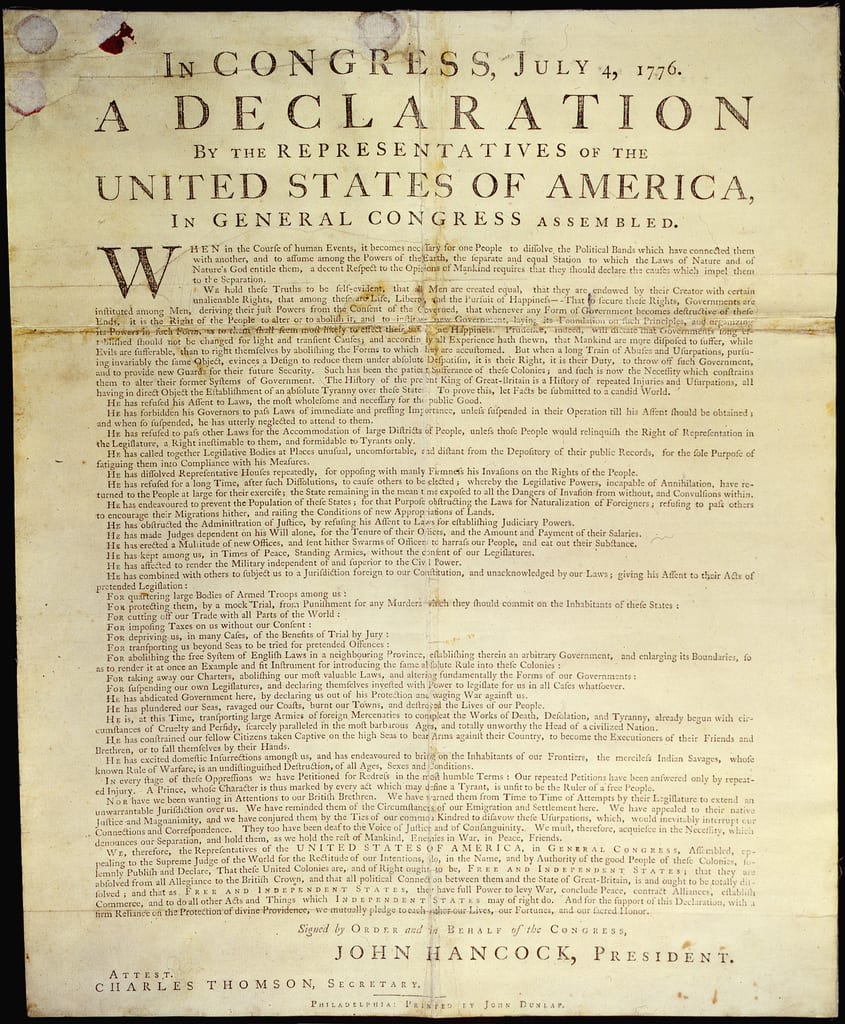
The Founding Era: Building a New Nation America's story begins with bold ideas about freedom and self-governance. In 1776, the Declarati...
-
📜 Was the Old Testament Pro-Slavery? A Historical and Ethical Exploration The Old Testament is one of the most influential texts in human h...
-
To support newly freed African Americans, Congress created the Freedmen’s Bureau in 1865—the first federal welfare agency. It helped over 4 ...
-
The Supreme Court of the United States is the most powerful court in the world The Supreme Court: A Pillar of Justice and Constitutional In...