Monday, December 8, 2025
Final Presentation: Evolution of American Freedom
Saturday, December 6, 2025
Remembering the Tulsa Race Massacre of 1921
The Tulsa Race Massacre of 1921 remains one of the darkest and most devastating episodes in American history. At the time, Tulsa, Oklahoma, was home to Greenwood, a thriving African American community often referred to as “Black Wall Street.” Greenwood was a symbol of Black prosperity, with flourishing businesses, schools, churches, and cultural life. Yet, its success became a target for racial hostility in a segregated society.
On May 30, 1921, an encounter between Dick Rowland, a young Black man, and Sarah Page, a white woman, sparked rumors that quickly spread through Tulsa. Though the details were unclear, the incident inflamed racial tensions. By May 31, a white mob had gathered outside the courthouse where Rowland was being held. What began as a confrontation escalated into one of the worst acts of racial violence in U.S. history.

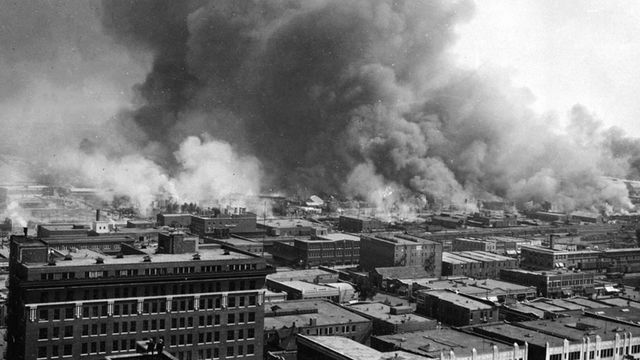
Over the next eighteen hours, Greenwood was systematically destroyed. White mobs looted homes and businesses, set fires, and even used airplanes to drop incendiary devices on the neighborhood. By the time the violence ended, as many as 300 Black residents had been killed, more than 1,000 homes and businesses were reduced to ashes, and thousands of survivors were left homeless. Many were detained in internment camps, stripped of their freedom and dignity.
The massacre was not only a physical destruction but also an erasure. Newspapers and officials largely suppressed the story, and for decades it was omitted from history books. Survivors rarely spoke of it, fearing retaliation and further trauma. Greenwood’s legacy was buried, and the tragedy remained hidden from national memory.
In recent years, however, the Tulsa Race Massacre has finally received the recognition it deserves. Survivors like Viola Fletcher, who lived to be 111, spent their lives advocating for acknowledgment and reparations. Their voices, along with renewed scholarship and activism, have brought Greenwood’s story back into public consciousness. Efforts to preserve the neighborhood’s legacy and honor its victims continue, ensuring that the truth is not forgotten.

Today, the massacre is recognized as one of the worst incidents of racial violence in U.S. history. It serves as a powerful reminder of the destructive force of racism and the resilience of those who endured unimaginable loss. Remembering Greenwood is not only about honoring the victims but also about confronting the past to build a more just future.
AI Disclosure: This post was drafted with the assistance of Microsoft Copilot, an AI companion designed to help synthesize information and create clear, structured writing.
The Rise and Decline of the KKK in the 1960s
The 1960s were a defining era in American history, shaped by the Civil Rights Movement and the violent backlash it provoked. Among the most notorious forces of resistance was the Ku Klux Klan. The Klan’s resurgence during this decade was fueled by the push for desegregation after Brown v. Board of Education and the growing visibility of civil rights activism. Although fragmented and not always unified, the Klan gained support from certain politicians, police officers, and public officials, using propaganda, rallies, and violent intimidation to spread fear.
Freedom Summer in 1964 highlighted the Klan’s brutality. Civil rights workers James Chaney, Andrew Goodman, and Michael Schwerner were murdered while investigating the burning of a Black church in Mississippi. This tragedy underscored the risks activists faced while registering Black voters. Similarly, the bombing of Birmingham’s 16th Street Baptist Church in 1963 killed four young girls and injured dozens more, shocking the nation and strengthening support for civil rights legislation.

Despite “massive resistance” to school desegregation and symbolic acts like Governor George Wallace’s “stand in the schoolhouse door” at the University of Alabama, progress could not be stopped. Landmark legislation followed: the Civil Rights Act of 1964 outlawed segregation and employment discrimination, while the Voting Rights Act of 1965 banned literacy tests and poll taxes, dramatically increasing Black voter registration.
Grassroots activism also played a crucial role. The Greensboro sit-ins of 1960 inspired hundreds of similar protests, while the March on Washington in 1963 brought over 200,000 people together to hear Martin Luther King Jr.’s iconic “I Have a Dream” speech.
By the late 1960s, the Klan’s influence declined as federal enforcement, public outrage, and civil rights victories reshaped the nation. The decade proved that while hate groups could terrorize, they could not stop the march toward justice.
AI Disclosure: This blog post was drafted with the assistance of Microsoft Copilot, an AI companion designed to help synthesize information and create clear, structured writing.
Final Presentation: Evolution of American Freedom
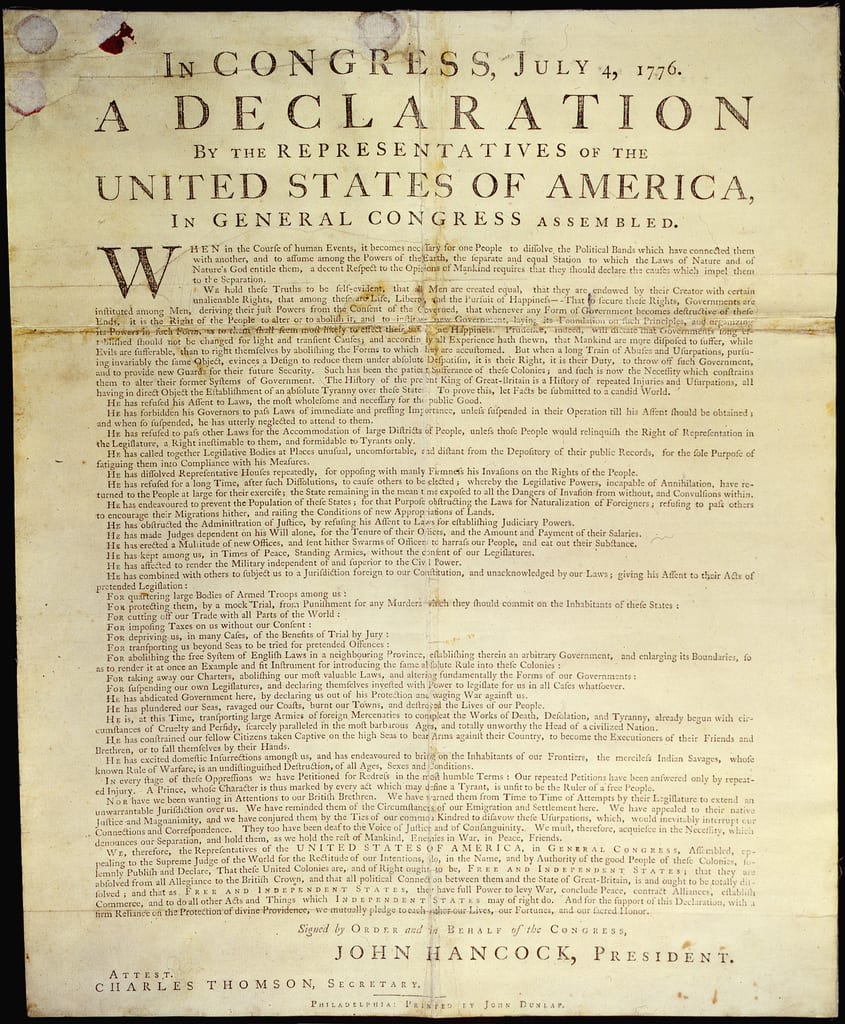
The Founding Era: Building a New Nation America's story begins with bold ideas about freedom and self-governance. In 1776, the Declarati...
-
📜 Was the Old Testament Pro-Slavery? A Historical and Ethical Exploration The Old Testament is one of the most influential texts in human h...
-
In 1829, North Carolina witnessed one of the most morally complex and legally significant cases in its history: State v. John Mann. At the ...
-
The Supreme Court of the United States is the most powerful court in the world The Supreme Court: A Pillar of Justice and Constitutional In...